Key takeaways:
An accounts payable workflow is the process a business uses to capture, review, approve, pay, and record vendor invoices.
A weak accounts payable workflow has company-wide impacts, from cash flow visibility and vendor relationships to audit readiness and your team energy.
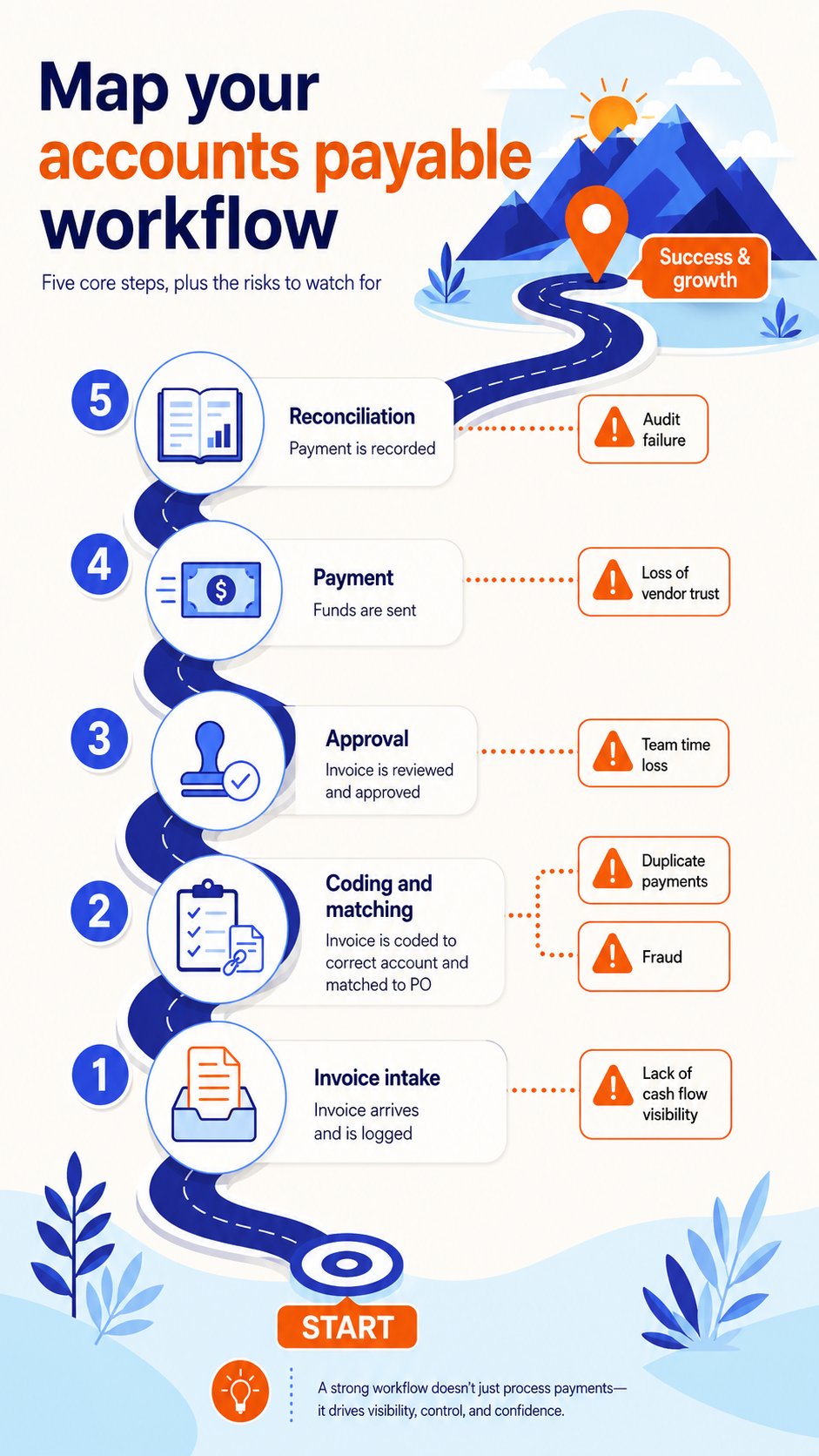
Most accounts payable workflows share five core steps: invoice intake, coding and matching, approval, payment, and reconciliation.
There are a handful of common AP workflow missteps that crop up even in savvy companies.
Troubleshoot with five red flags that can help you diagnose where your accounts payable workflow is breaking down.
What is an accounts payable workflow?
At its most basic level, an accounts payable workflow is the process you use to make sure bills get logged and paid. How complex that workflow is depends on how complex the invoices you’re handling are. A college student might just need a basket on the kitchen counter to toss bills into until she pays them. But businesses, especially growing businesses need a much more robust process.
A typical business accounts payable workflow includes
How invoices are captured
Who reviews and approves them
How payments are issued
How the transaction is recorded in your books
The difference between a good and bad accounts payable workflow? Let’s go back to that basket. The one that the college kid throws their bills into and then forgets. If late notices are stacking up, the bank account is overdrawn, and the lights have been turned off, well, we can safely say that’s a bad accounts payable workflow!
All joking aside, that’s the criteria even for the most complex corporate accounts payable workflow. If the workflow is working well, no one notices it. If it’s not working well, late payments, missed errors, and last minute scrambling start to show up.
Why your accounts payable workflow matters more than you thinK
Maybe that doesn’t seem so bad. A few late payments. Not the end of the world. It’s just a back-office function that has to get done, right? Wrong.
Your accounts payable workflow touches almost every part of your business.
Cash flow visibility
Vendor relationships
Risk and fraud prevention
Audit and compliance readiness
Team time and focus
Strategic decision-making
If you don’t have a clear picture of who you owe what and when, you can’t make good strategic decisions about spending and hiring. Vendors who are paid on time consistently trust you and are more apt to offer beneficial terms of service. Duplicate payments, coding errors, and fraud can slip through the cracks in a leaky accounts payable workflow, leaving you vulnerable during a compliance audit.
Bottom line? Your accounts payable workflow is worth tuning up!
The core steps in an accounts payable workflow
Every company’s process will look a little different, but all AP workflows share these key components:
Invoice intake: The invoice arrives and gets logged into your system.
Coding and matching: The invoice gets matched with the appropriate account and/or PO
Approval: The invoice is reviewed and approved
Payment: Payment is sent in alignment with terms
Reconciliation: Payment is recorded in your books
Each of these steps is an opportunity for efficiency and accuracy or for something big to slip through the cracks.
Where account payable workflows commonly break down
We’ve seen a lot of different accounts payable workflows, and while we don’t believe there’s one perfect process that works for everyone, there are some common missteps that we’ve seen even the most savvy companies make.
Manual entry errors
If your invoices are being keyed-in manually, it opens you up to manual entry errors like typos and miscoding. These small mistakes can compound over time. Automation helps ensure accuracy and consistency.
Approval bottlenecks
When companies are growing fast, they often hit a transition phase where the one person who has always been in charge of handling invoice approvals suddenly can’t keep up. Ten invoices a month becomes 20 and then 100 until late notice pile up while the invoices sit on the approver’s desk awaiting review.
Duplicate payments
If invoices aren’t accurately and consistently matched to accounts and POs, they can end up being paid twice. That leaves you reliant on the honesty (and vigilance) of your vendors to catch the double payment, inform you, and refund the money.
Missed and late payments
On the flip side, if invoices aren’t coded and matched properly, they may get missed altogether until a vendor flags a late payment. That erodes trust and lowers your ability to negotiate for better terms and priority service. And, it can result in an account hold until the balance is caught up, which can be a costly delay.
No single source of truth
If you don’t have a comprehensive accounts payable tracking system, invoices end up in various inboxes, payments are sent in a variety of forms from different staff members, and it becomes nearly impossible to know what was paid when by whom to whom.
5 signs your accounts payable workflow needs a second look
Think you might be suffering from one of these accounts payable workflow challenges? Here’s a quick troubleshooting guide to help you diagnose the most common problems.
| Red flag | Possible cause | Solution |
|---|---|---|
| Payments are often late | Approval bottleneck or confusion | A defined, documented approval workflow |
| Cash flow surprises at month end | Invoices aren’t being tracked accurately | Centralized invoice intake and coding |
| Duplicate payments | No matching or verification step before payment | Standard invoice-PO-payment matching |
| No one’s sure exactly how invoices get paid | No or under-documented workflow | Process documentation and cross-training |
| Not sure which invoices are currently outstanding | No real-time visibility into AP status | A system built for reporting, not just recordkeeping |
Recognize some of these red flags? Don’t worry, they’re incredibly common, and simple to fix with some strategic planning and implementation support.
Were Aerial fits in
We’ve seen the best and the worst when it comes to accounts payable workflows, and we have an experienced team that can adapt best practices to your specific business context. Whether you’re an small company just building your accounts payable workflow or a large, growing business needing to keep up with increased invoice volume and complexity, our experts will work along you to ensure you have an accounts payable workflow that keeps you on track as you scale.
Schedule a quick call here to explore how we can help you optimize your processes.